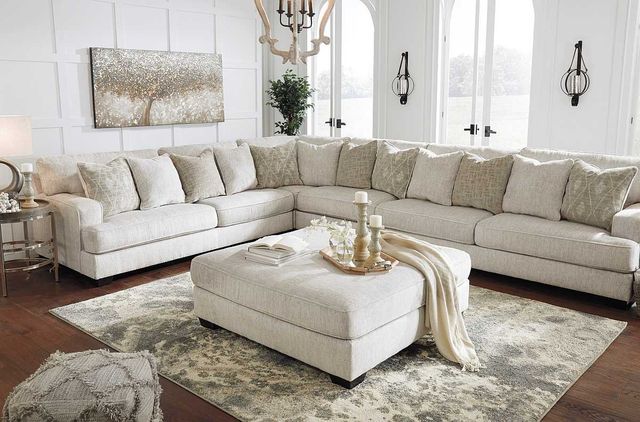
The tape measure said it would work. A 132-inch u-shaped sectional against a family room wall that ran 168 inches, with the return piece angled back toward the fireplace. The pieces connected fine on delivery day, and then the gap between the front of the chaise cushion and the raised hearth measured 18 inches. Nobody could walk that path without turning sideways, and the corner seat that was supposed to be the best spot in the house turned into the one nobody used. That is the trap with large sectional sofas, because overall width is the easiest number to check and the least likely to be the one that fails you. Walkways, chaise orientation, seat depth, and the doorway the crew has to carry it through are what actually decide whether the room works.
Find a Large Sectional That Fits Your Room and Your Family
Our team sizes sectionals to real room measurements, checks your delivery path before the order is written, and handles delivery, setup and removal of the old piece. Shop configurations in one place, with financing available.
Explore large sectional sofasEvery one of those problems is catchable before the order is written, and catching them takes a tape measure and about twenty minutes. Our team at Store For Homes Furniture & Flooring in Newton, Iowa has sized seating for farmhouse living rooms, split-level family rooms, and finished basements long enough to know exactly where the numbers go wrong. This guide walks through what actually counts as a large sectional, how to measure the room instead of just the wall, how the major configurations compare side by side, how to get the chaise on the correct side the first time, what seat depth and cushion fill really do for comfort, which upholstery survives kids and pets, and how to measure the delivery path before you sign the order.
Key Takeaways
- Large starts around 110 inches: Large sectional sofas generally measure 110 inches or more along the longest side, seat five to seven people, and arrive as two or more pieces that connect in your room.
- Measure the room, not the wall: Keep the sofa to roughly two thirds of its wall, leave 30 to 36 inches of walkway, and allow 16 to 18 inches between the seat front and the coffee table.
- Facing direction is described from the front: Left arm facing and right arm facing refer to the arm position as you look at the sofa, and most fixed configurations cannot be flipped after delivery.
- The delivery path fails more orders than the floor plan: Compare the door and stair openings against each piece’s diagonal, since a piece can pass at an angle even when it is wider than the door.
What Counts as a Large Sectional Sofa? Sizes, Seating, and Terminology

A large sectional sofa generally measures 110 inches or more along its longest side, seats five to seven people, and ships in two or more separate pieces that connect on site. Anything past roughly 130 inches per side, or any u-shaped model with two returns, is usually sold as an oversized sectional sofa.
Those categories matter because they change how you shop. Here is where the real size tiers fall.
- Apartment scale: roughly 80 to 95 inches along the longest side, seating two to three.
- Standard chaise sectional: roughly 100 to 110 inches, seating three to four.
- Large: roughly 110 to 130 inches per side, seating five to six.
- Oversized or u-shaped: 130 inches and beyond, seating six to eight.
Decoding the Abbreviations on the Tag
Product pages and showroom tags use a shorthand that trips up first-time buyers. These are the terms worth knowing before you shop.
- LAF and RAF: left arm facing and right arm facing, describing which end carries the arm.
- Armless chair: a seat section with no arms, used to add length in the middle of a run.
- Corner wedge: the angled or square piece that turns the sofa 90 degrees.
- Return: the shorter leg of an L or a U that comes back toward the room.
- Cuddler: an oversized rounded seat, usually wider than a single cushion but narrower than two.
- Ottoman and console: add-on pieces for a footrest or for cupholders and storage between seats.
The single most common ordering mistake happens right here. Facing labels describe the arm position as you stand in front of the sofa looking at it, not as you sit on it. Get that backwards and a right arm facing chaise lands in the walkway instead of against the window.
Seating Capacity Is Not the Same as Width
Overall width tells you what fits the wall. Cushion layout tells you how many people actually sit down. Adults need roughly 22 to 30 inches of seat width each, so two sectionals of identical overall width can seat different numbers of people depending on how the cushions are divided.
Here is the part most guides skip. A chaise or a corner wedge counts as roughly one and a half adult seats, not two, because the corner cushion loses usable space to the wedge and the chaise is designed for one person to stretch out. If you need a true 6 seater sectional sofa for game nights, count cushions and measure their widths rather than trusting the seat number in the listing.
Read more:
- 5 Creative Living Room Furniture Pieces for a Cozy Home
- Sofa vs Couch: Is There Actually a Difference?
How to Measure Your Room for Large Sectional Sofas

Measuring in the right order keeps you from discovering a problem after the order is placed. Work through it the same way every time.
- Measure the wall the sofa will sit against, at floor level and again at 18 inches up, since baseboards, sills and vents change the usable length.
- Measure the room depth from that wall to whatever sits opposite it.
- Measure ceiling height, especially in a basement or under a stair soffit.
- Mark the obstructions: windows, floor registers, outlets, the fireplace hearth, stair openings, and the full arc of every door swing.
The Sizing Rules and Why They Work
Three numbers do most of the work in a living room layout. Keep the sofa to roughly two thirds of the wall it sits against, so the piece reads as furniture rather than as a second wall. Leave 30 to 36 inches of clear walkway on any main traffic path, which is the width a person carrying a laundry basket actually needs. Allow 16 to 18 inches between the seat front and the coffee table, since less than 16 blocks your legs and more than 18 puts your drink out of reach.
Room size sets the outer limit. An l shaped sectional generally needs about 12 by 12 feet of usable space to work without crowding. A u shaped sectional sofa usually wants closer to 15 by 18 feet, because two returns eat into the room from both sides at once.
Tape the Footprint Before You Order
- Outline the full footprint on the floor with painter tape, including the chaise or return, not just the main run.
- Add a second line 16 to 18 inches out for the coffee table.
- Set a dining chair at the tape edge and walk the room the way you normally would, including the path to the kitchen and the door you use most.
- Live with the outline for a full day before you commit. A footprint that annoys you on a Tuesday will annoy you for the next decade.
Back height is the sizing factor almost every guide leaves out. With standard eight-foot ceilings, or with a sight line from the living room into a dining area, a back height under about 36 inches keeps the room open instead of walled off. Taller backs feel great in a two-story great room and heavy everywhere else.
Before you shop, write down this short list: wall length, room depth, ceiling height, walkway width on both main paths, distance to the coffee table, and the location of every window, vent and door swing. Those six numbers answer nearly every large sectional sofa dimensions question a salesperson will ask you.
U-Shape vs L-Shape vs Chaise vs Modular: Comparing Large Sectional Sofas
Find the row that matches your room and read across. Every figure below is a typical range across collections, not a guarantee, so the final numbers always come from the manufacturer spec sheet for your exact model and piece count.
| Configuration | Typical Overall Size | Seating Capacity | Minimum Room Size | Best Room Layout | Traffic Flow Impact | Rearranging Flexibility | Watch Out For |
|---|---|---|---|---|---|---|---|
| L-Shaped Sectional | 110 to 130 inches | 5 to 6 | 12 by 12 feet | Corner placement | Low | Limited once ordered | Facing direction |
| U-Shaped Sectional | 130 inches and up | 6 to 8 | 15 by 18 feet | Large open great room | High | Very limited | Blocked walkways |
| Chaise Sectional | 100 to 120 inches | 4 to 5 | 11 by 12 feet | Media wall or corner | Low | Limited | Chaise in the path |
| Modular or Pit Sectional | Varies by piece count | 5 to 8 | 13 by 15 feet | Open-concept zoning | Low to moderate | Highest | Pieces drifting apart |
| Reclining Sectional | 110 to 135 inches | 5 to 6 | 13 by 14 feet | Dedicated TV room | Moderate | Limited | Rear recline clearance |
| Sleeper Sectional with Storage | 105 to 125 inches | 4 to 6 | 12 by 14 feet | Guest-duty family room | Moderate | Limited | Open floor to unfold |
Three takeaways come out of that table. A u-shaped or modular group suits an open-concept great room where the sofa itself has to draw the line between living and dining space, while an l-shaped or chaise sectional is the better answer when the piece tucks into a corner and the rest of the floor stays clear. If your room has more than one doorway to keep open, a chaise sectional or a modular group is realistic and a u-shape usually is not.
Modular designs are also the only category on that list you can genuinely rearrange later. Everything else is a one-layout decision, which is why the next section matters as much as it does.
Choosing Orientation and Chaise Side for Large Sectional Sofas
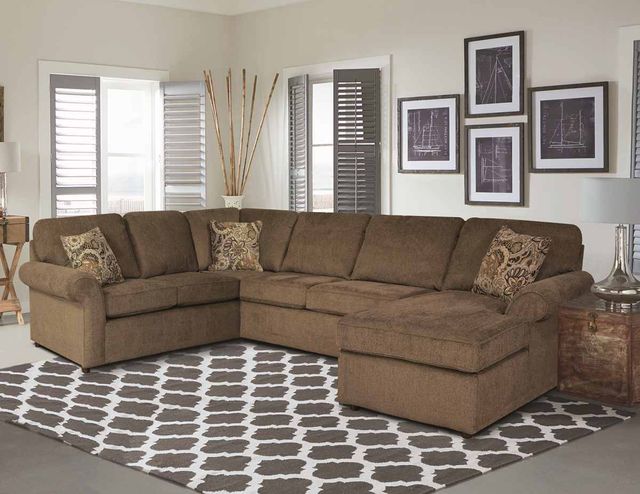
Getting the facing direction right is a three-step process, and it takes about a minute.
- Stand in the main doorway looking at the spot where the sofa will sit.
- Decide which end the long piece, the chaise or the return, should occupy.
- Translate that into left arm facing or right arm facing using the front-view rule: the label describes the arm as you look at the sofa, not as you sit on it.
Your layout drivers do the deciding for you. The television or media wall sets the viewing angle. Window placement decides where glare lands during the afternoon. A fireplace, the primary walking path into the room, and the side the room opens toward all pull the chaise one direction or the other. When two of those conflict, the walking path usually wins, because you use it every day.
Three Placement Strategies Worth Considering
- Corner tuck: the sofa fills a corner, keeps the rest of the floor open, and works best with an l shaped sectional.
- Floating divider: the sofa sits off the wall with its back defining the edge of a great room, separating living space from a dining or play area.
- Media centering: the sofa centers on the television wall so viewing angles stay even for everyone seated.
Reversible and modular sectional sofa designs are the hedge when the layout is genuinely uncertain, or when you expect to move within a few years. Be direct with yourself about the alternative, though. Most fixed-configuration sectionals cannot be flipped later, so for that room the choice is effectively permanent.
The test competitors never mention is how your household actually sits. Note who claims the chaise for naps, which side the reader in the family sits on and where a lamp and side table have to land for them, and whether the chaise ends up blocking the outlet that charges everything. Sketch the room with measurements and doorway locations, bring it into the Store For Homes Furniture showroom, and have a salesperson confirm the orientation before the order goes in. That five-minute conversation prevents the most expensive mistake in the category.
Seat Depth, Cushion Fill, and Frame Quality: What Comfort Really Depends On
Comfort is measurable, so shop it with numbers instead of adjectives. Five specifications tell you nearly everything.
- Seat depth: 21 to 23 inches is standard, and a deep seated sectional runs 24 inches or more.
- Seat height: commonly 17 to 20 inches from the floor to the top of the compressed cushion.
- Seat width: roughly 22 to 30 inches per adult across the cushion layout.
- Back height: under 36 inches keeps sight lines open, above that feels enclosing.
- Arm height: decides whether the arm works as a pillow rest or only as a boundary.
Depth is the one that divides people. Deep seats reward lounging, movie nights, and taller adults who want their whole back supported. Shallower seats are easier for shorter adults, for older adults, and for anyone who needs to stand up without pushing off the arm. If the household splits on that, a mid-range sectional sofa seat depth around 22 to 23 inches with a well-shaped back cushion satisfies more people than either extreme.
Cushion Fill and What Each One Asks of You
- High-resiliency foam: holds its shape longest and needs the least attention.
- Foam wrapped in fiber or a down blend: softer surface over a foam core, and it needs regular fluffing.
- Spring-down: coil support inside a down wrap, plush and supportive, usually the highest price.
- Pocketed coil seat cores: individually wrapped coils under the foam, firmest support and the most consistent feel across a long run of cushions.
The trade-off is honest and simple. Softer fills feel better on day one and need fluffing and rotating to keep their shape, while firmer foam and coil cores look less inviting in the showroom and hold up better over five years.
Frame and suspension are the longevity signals. Look for kiln-dried hardwood frames, corner-blocked and doweled joinery rather than staples alone, and either sinuous spring or eight-way hand-tied suspension. On a sectional there is one extra item that a single sofa never has, which is the connector hardware joining the pieces. Metal bracket-and-hook connectors hold alignment far better than plastic clips.
When you sit-test in the showroom, work through this list. Sit for at least five minutes, not ten seconds. Sit with your feet flat and your back against the cushion. Test the corner seat and the chaise separately, since they rarely feel the same as the main run. Then push the pieces apart with your hands and see how firmly the connectors hold.
Large Sectional Sofas Pros and Cons Every Buyer Should Weigh
A large sectional buys you more seating per dollar than any other way of filling a family room, and it asks for flexibility in return. Weigh both lists against how your household actually uses the room, not against how it looks in a photograph.
Pros
Maximum seating without extra chairs
One piece can seat five to seven people, which handles a full family plus guests without dragging in dining chairs or adding a recliner that crowds the floor.
Defined zones in open-concept rooms
The back of a sectional draws a clean line between the living area and a dining or play space, doing the job a wall would do without closing the room in.
Real lounging and sleeping comfort
A chaise or a corner gives someone a place to stretch out fully, and sleeper models turn the family room into a guest room on short notice.
Better value per seat
Buying one sectional usually costs less per seat than a sofa plus a loveseat plus a chair, and it leaves budget for better cushion fill or performance fabric.
Upgrades you cannot get from separate pieces
Power recline, chaise storage, drop-down consoles and sleeper mechanisms are all built into the run rather than bolted on afterward.
Cons
The room layout is locked in
Most fixed configurations cannot be reversed later, so rearranging the room means living with the sofa where it is or replacing it.
Delivery access is harder
More pieces means more openings to clear, and an oversized footprint takes usable floor space that a smaller group would have left open.
Read more:
- Best Dining Room Table Set Brands for Style, Durability, and Value
- Sealy Mattress Collections Explained: Posturepedic & Essentials
Upholstery and Durability: Choosing Fabric or Leather for Everyday Use
The cover outlasts the decision, and on a sectional it takes daily use across every cushion. Here is how the main families really perform.
- Performance fabric: solution-dyed polyester and polypropylene blends resist stains and fading better than anything else at the price, which is why a performance fabric sectional is the default recommendation for family rooms.
- Chenille and boucle: soft and warm looking, though loose loops can snag on pet claws.
- Top-grain leather: the most durable long-term surface, wipes clean, and develops character rather than wearing out.
- Bonded or faux leather: the lowest cost of the leather-look options, and the surface layer can peel with heavy daily use.
The Durability Number Most Retailers Never Show You
Upholstery is rated in double rubs, an abrasion test that measures how many passes a fabric takes before it shows wear. Heavy-duty residential upholstery generally tests well above 15,000 double rubs. Ask for that number on any cover you are considering for a room the family uses every night.
Cleaning codes matter just as much, and they appear on the tag as a single letter. W means water-based cleaners, S means solvent-based only, WS means either, and X means vacuum only with no liquid at all. Buying an X-code fabric for a house with toddlers is a decision you will regret the first time juice hits it.
For kids and pets, three practical rules hold up. Tight weaves resist snagging better than loose loops. Mid-tone and textured colors hide wear and pet hair far better than solid light or solid dark flats. Removable cushion covers change long-term maintenance completely, since a cover you can take off is a cover you can actually clean.
Iowa adds a few wrinkles worth planning around. Strong south and west window exposure fades dark fabrics over a few summers and dries out leather. Dry winter air with the furnace running makes leather more likely to crack without periodic conditioning. Low humidity also raises static, which pulls dust and pet hair onto some synthetics faster than you would expect.
Care is simple if you actually do it. Vacuum weekly with a brush attachment, rotate and flip any reversible cushions monthly, blot spills instead of rubbing them, and follow the cleaning code on the tag rather than reaching for a household spray.
Delivery, Doorways, and Setup: Getting Large Sectional Sofas Into the Room
Measure the path before you sign, in this order.
- Front door clear width and height, measured with the door open and the weather strip in place.
- The narrowest hallway on the route.
- Every tight corner the crew has to turn.
- Stairwell width, landing depth, and ceiling height at the turn.
- Elevator interior dimensions if the room is in a building with one.
- Railing and newel post clearance on any staircase.
Then apply the diagonal rule. Crews tip a piece on its side and walk it through, so the measurement that has to clear the frame is the diagonal from the top of the back to the front edge of the seat deck, not the overall width. A piece that measures 38 inches deep can pass through a 34-inch opening at an angle when the diagonal cooperates.
Here is the professional detail worth knowing before delivery day. Taking the door slab off its hinges buys roughly 1.5 to 2 inches of clear width, and it takes about ten minutes with a hammer and a nail set to drive the hinge pins up and out. That is often the exact margin a tight entry needs.
Multi-piece and modular designs are the reliable answer for hard access, because each section travels on its own. Legs usually unbolt, back cushions come off, and on many designs the sofa backs themselves detach from the seat frame. That last one is what turns an impossible stairwell into a manageable one.
Confirm these at the time of order rather than after. Ask for the piece count and per-piece carton dimensions. Ask whether delivery includes in-home placement, assembly, packaging removal, and haul-away of the old furniture. Ask directly who is responsible if a piece cannot make the turn, because that answer differs enormously between a local retailer and a freight carrier.
This is where buying local stops being sentimental and starts being practical. Store For Homes Furniture handles professional delivery and setup, hauls away the old sofa or mattress, and backs the sale with its own service department in Newton. An online-only seller drops a stack of cartons at the curb and leaves the stairwell problem to you.
The Lead Time Trade-Off: Built to Order Versus In Stock
There is a decision underneath the shape and fabric questions that nobody puts on a checklist, and it is the one that most often determines satisfaction two years later. A built-to-order sectional is made after you buy it, which means you choose the configuration, the chaise side, the cover, the cushion and the arm style, and you wait several weeks for it. An in-stock sectional exists right now in a warehouse in one fixed configuration and one color, and it can be in your living room in days. Neither is better in the abstract. The right answer depends entirely on which constraint is real for you: the date, or the room.
- Choose built to order when the room is unusual, when the chaise has to land on a specific side, when you need a particular seat depth or arm style, or when a household with pets makes the performance fabric selection the whole point.
- Choose in stock when a move-in date, a holiday, or a room that is currently empty sets a hard deadline you cannot negotiate.
- Choose built to order when the sofa is a ten-year purchase and the color has to work with a rug and a wall you are keeping.
- Choose in stock when you want to sit on the exact piece you are buying before you pay for it, rather than sitting on a floor sample in a different cover.
- Ask about current production times before you decide, since lead times shift by manufacturer and by season and a two-week difference can settle the whole question.
Read more:
Featured Large Sectional Sofas at Store For Homes Furniture
The sectionals below cover the range described above, from American-made customizable frames you configure yourself to a ready-to-deliver four-piece group. Five of the six are England Furniture models built to order, which means the configuration, cover and details are yours to choose rather than whatever happens to be on the floor. Confirm exact dimensions, piece counts and cover options on each product page or with our team in Newton before you order.
England Furniture Customizable Angie Sectional

Orientation is the one decision you cannot undo after delivery, which is exactly where a built-to-order frame earns its keep. Angie is made in America by England Furniture and built after you buy it, so the chaise side and the piece layout are chosen for your room rather than picked off a floor tag. Use the doorway test from earlier in this guide, decide which end the long piece should occupy, then have that translated into left arm facing or right arm facing before anything is cut. Bring a room sketch to our Newton showroom and the configuration gets confirmed with you.
Top Features
- Built to order in America: Production starts after your order is written, so the configuration is matched to your room instead of to warehouse stock.
- Chaise side chosen at order time: Left arm facing or right arm facing is settled before the frame is built, which removes the most common sectional mistake.
- Configurable piece layout: Work with our team to set the run length and the piece count around your wall and walkways.
- Delivery and setup included: Local delivery, in-home placement, and haul-away of the old piece are handled by our own crew.
England Furniture Customizable Brantley Sectional

Households with a dog, a toddler, or both need the cover decision to come first and the styling second. Brantley is customizable, so the upholstery is selected from a range of covers rather than accepted as-is, which is the practical way to put a performance fabric on a family room sectional. Apply the durability rules from earlier: ask for the double rub rating, check the cleaning code letter on the cover you like, and lean toward a tight weave in a mid-tone that hides pet hair. Our team can pull cover samples so you compare them in person.
Top Features
- Cover selection at order time: Choose the upholstery for the household you actually have rather than settling for a warehouse color.
- Performance fabric options: Ask about solution-dyed covers built to resist staining and fading in a high-traffic family room.
- Cleaning code guidance: Our team explains the W, S, WS and X codes so the cover matches how you will clean it.
- American-made construction: England Furniture builds each order in its own plant rather than importing finished stock.
- Sample comparison in Newton: Compare covers side by side in the showroom before committing.
England Furniture Customizable Malibu Sectional

Not every great room measures 15 by 18 feet, and forcing an oversized footprint into a modest one is how walkways disappear. Malibu is worth a look when the room sits on the smaller side of large and scale is the deciding factor. Because it is built to order, the run length and seat configuration are set to your measured wall rather than a standard floor model. Take the two-thirds wall rule from earlier, bring your numbers to the showroom, and ask our team to confirm the current seat depth against your sketch.
Top Features
- Scaled to your measurements: The configuration is built around your wall length instead of a fixed warehouse size.
- Seat depth confirmation: Ask our team for the current seat depth specification so the fit matches who sits on it.
- Walkway-conscious planning: We size the run to protect the 30 to 36 inches of clear path a family room needs.
- Made to order in America: Each frame is produced after purchase by England Furniture rather than pulled from stock.
England Furniture Customizable Thomas Sectional

Arm style is the quiet variable that changes both the footprint and the feel of a sectional. Thick rolled arms add width you pay for twice, once at the wall and once in visual bulk, while narrower arms return those inches to the seat. Thomas is a customizable England Furniture frame, so the details that shape that silhouette are chosen at order time rather than inherited. If your wall measurement is tight, this is the model to discuss when a few inches of arm width decide whether the piece reads as furniture or as a barricade.
Top Features
- Detail choices at order time: Style and finish decisions are made for your room instead of accepted from stock.
- Footprint-aware fit: Arm and frame choices affect overall width, which matters when the wall leaves little margin.
- Configurable layout: Set the run and the return around the walking path into the room.
- Built after you buy: England Furniture produces the order in America once the specifications are locked in.
- Showroom sit test: Try a comparable frame in Newton before the order is written.
England Furniture Customizable Seneca Falls Sectional

A family room that doubles as the guest room asks more of a sectional than seating. Seneca Falls is the one to ask about when added function is the goal, since a customizable England Furniture order is where sleeper and storage upgrades get specified rather than wished for later. Remember the clearance point from earlier, because any sleeper needs open floor in front of the frame to unfold. Ask our team which upgrades this frame supports, then tape the extra footprint on the floor before you decide. That check keeps a good idea from becoming a crowded room.
Top Features
- Upgrade options discussed at order: Ask which sleeper, storage or console additions this customizable frame supports.
- Guest-duty planning: Our team helps you allow the open floor a sleeper mechanism needs in front of the piece.
- Configuration built to your room: Piece layout and chaise side are set before production begins.
- American-made by England Furniture: Built to order in the manufacturer’s own plant rather than stocked overseas.
Signature Design by Ashley Rawcliffe 4-Piece Parchment Sectional

When a move-in date or a holiday sets the deadline, waiting several weeks for a custom build is not an option. This four-piece Ashley sectional is the in-stock answer, arriving in a defined configuration and a set parchment color rather than a menu of choices. Four separate pieces also help on tight stairs and doorways, since each one travels through an opening on its own. Be honest about the light finish, though, because parchment shows soil sooner than a mid-tone and rewards weekly vacuuming and prompt blotting. It suits an adult household or a formal living room best.
Top Features
- In-stock availability: A ready-to-deliver option when the calendar, not the configuration, is driving the purchase.
- Four-piece construction: Separate sections make tight doorways, hallway corners and stairwells far more manageable.
- Defined configuration: The layout is fixed, so confirm the orientation against your room before ordering.
- Light parchment finish: A bright neutral that opens up a room and asks for more consistent cleaning than darker covers.
- Local delivery and setup: Our crew places, assembles and removes packaging rather than leaving cartons at the curb.
Choosing Among Large Sectional Sofas With Confidence
The decision comes down to five checks. Match the configuration to the room instead of the wall, verify the footprint and walkways with tape on the floor, confirm the chaise side and seat depth against how your household really sits, choose upholstery for the kids and pets you actually have, and measure the delivery path before you sign the order. Handle those five and the rest is styling.
When you are ready, compare large sectional sofas in person at Store For Homes Furniture & Flooring in Newton. Our family-owned store lets you sit-test configurations side by side, walk through England Furniture cover options with someone who has sized seating for homes like yours, and get honest guidance about what will and will not fit through your front door. We deliver and set up, remove the old furniture and mattress, offer buy-now-pay-later financing and extended warranties, and back the sale with our own service department right here in Iowa. We also ship nationwide, so distance is not the obstacle it used to be. That combination is what an independent retailer offers and a big-box floor or a curbside freight drop simply does not.
Frequently Asked Questions About Large Sectional Sofas
A sectional is generally considered large when it measures 110 inches or more along its longest side and seats five to seven people. Models past roughly 130 inches per side, including most u-shaped designs with two returns, are usually marketed as oversized instead.
A u-shaped sectional is better when the room is genuinely large and open, roughly 15 by 18 feet or more, because it creates conversation seating on three sides. An l-shaped sectional is the safer choice in a 12 by 12 foot room or any space with more than one doorway to keep clear.
Leave 30 to 36 inches of clear walkway on every main traffic path and 16 to 18 inches between the seat front and the coffee table. Those two figures preserve normal movement through the room even when the sofa itself fits the wall perfectly.
Stand in the main doorway looking at where the sofa will sit and decide which end the chaise should occupy, then apply the front-view rule, since left arm facing and right arm facing describe the arm position as you look at the piece. Most fixed-configuration sectionals cannot be reversed after delivery, so confirming the direction before the order is written is the only reliable safeguard.
Most large sectionals fit through a standard 32 or 36 inch door because they arrive in separate pieces that are carried in one at a time and tipped on their side. Compare each piece’s diagonal depth against the door opening rather than its width, and remember that removing the door slab from its hinges gains roughly 1.5 to 2 inches.
Top-grain leather and solution-dyed performance fabrics are the most durable covers for a large sectional in daily family use. Look for a double rub rating well above 15,000 and check the cleaning code letter on the tag so the cover matches how you plan to maintain it.
Why Trust Store For Homes Furniture & Flooring?
When it comes to furnishing your space, you deserve a partner that prioritizes quality, value, and integrity. Store For Homes Furniture & Flooring is a proud, family-owned local business dedicated to helping you bring your unique vision to life. Our team brings superior product knowledge and expert service to every interaction, ensuring you feel entirely confident in your investment. We handle everything from curated quality brands to seamless delivery and setup, making it easier than ever to design a home you truly love.
Shop Large Sectionals in Newton, IA Today
Ready to upgrade your comfort? Skip the corporate guesswork and shop local with the experts who care. We invite you to explore our massive selection of furniture, mattresses, and flooring online or visit our showroom right here in Newton, IA. If you have questions about specific collections, custom options, or financing, our team is standing by to help. Head over to our Contact Us page or give us a call at 641-792-2240 to connect with a local specialist today.